
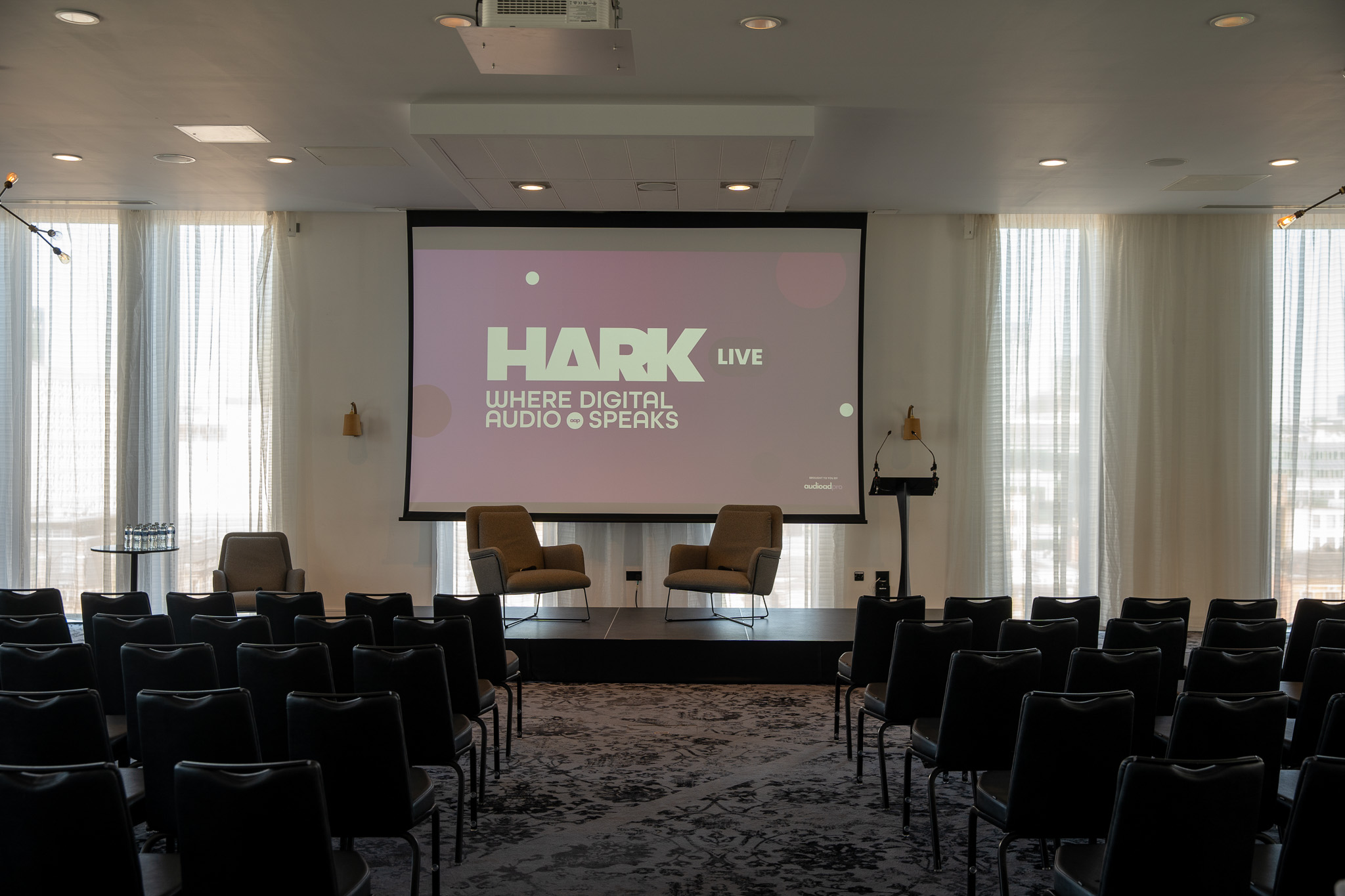
HARK Collective (brought to you by audioadpro) took to the stage at voco Manchester on 29th April 2026, and the digital audio community showed up. The mission for the day was to bring the sector together, create the conditions for honest conversation, and discuss how understanding your audience is key to successful digital audio advertising.
The feedback from delegates said it better than we could. As Penny Lee Taylor-Brown put it: “Watch out for HARK Collective. I went to their inaugural HARK Live this week, and it was an incredible day – informative, good for the soul, and hugely productive. Total success and can’t wait for the next one.” Others echoed that sentiment: “I thought it was a brilliant event, really insightful and definitely reframed my thinking on audio as a viable performance channel.” And perhaps the line that resonates most: “You brought together the industry, and didn’t just focus on data – it also had a ‘human’ element to it too, and showed there’s a real life to consuming media.”
That last point is exactly what HARK Collective is here to do. With speakers from Get Carter Productions, Distorted, Humanise, Audiomob, Octave and That ACCENT – plus audience intelligence from Media Datak and a live version of the Decommissioned Podcast – the day covered the full picture: creative, strategy, empathy, data, culture.
Here’s what each session brought to the room.
Get Carter Productions: We Need To Talk About The Ws
Ben Morris from Get Carter Productions opened with a reframe that landed early and stuck throughout the day: digital audio deserves creative that is fit for purpose, not just an ad reused from broadcast radio, because the environment people listen within has changed entirely. When someone chooses a podcast, a playlist or a game, they’ve made an active decision to be there. And when an advertiser enters it, the old licence to interrupt no longer applies.
Instead of what we want to say, it becomes: who are they, what do they need to know, why should they care, and when are they hearing this? The last point matters more than most briefs account for, as context (channel, moment, activity) shapes whether a message feels relevant or intrusive. Ben shared that getting it right isn’t just a creative preference; it’s the difference between an advertiser that belongs in a moment and one that breaks it.
This Is Distorted: Know Before You Grow
Five years ago, brands were asking what a podcast was. Now they’re asking how to launch one. 42% of UK adults listen to podcasts each month – and the challenge, as Becky and Alex from This is Distorted made clear, is that most brands skip the step that matters most. Before a format is chosen, before a host is briefed, before a single episode is recorded, you need to know who you’re actually making it for, and why they’d listen. Most podcasts that quietly disappear after episode four weren’t badly made; they were just built for no one in particular.
Podcasting is intimate. A loyal audience is worth more than millions of passive views, and the shows that earn that kind of attention are built on a clear purpose, honest audience understanding, and a realistic commitment to showing up consistently. As they put it simply: know before you grow, and everything else follows from there.
In Conversation with Paul Coleman, Humanise
Paul’s interview with audioadpro’s Roger Cutsforth asked an uncomfortable question: how well do brands actually know the people they’re talking to? The answer, more often than not, is not as well as they think. Through his work at Humanise, Paul’s team translate human truths into clear direction, bringing insight and strategy to life. The gap between what clients imagine and what customers actually say is almost always significant – and frequently surprising.
They discussed that surveys have limits and people give safe answers in structured settings. Where teal behaviour surfaces is in relaxed, conversational environments; the kind where someone mentions, almost as an aside, that they “watch TV” in the evenings but are actually pausing it mid-show to scroll TikTok. That kind of nuance doesn’t show up in multiple choice; it shows up in a proper conversation. The takeaway was simple: get closer to real people, and challenge your assumptions rather than confirm them. Curiosity, as Paul put it, is a professional skill, and one that the industry could use a lot more of.
Audiomob: Breaking Gaming Stereotypes
Carla Harrison from Audiomob came with data and used it to challenge myths about mobile gaming. The image of gaming as a niche pursuit is not just outdated, it’s a barrier to one of the biggest attention opportunities in media right now. 93% of people play mobile games on a weekly basis, 41% pay more attention to ads in mobile games than traditional placements, and 25% of women play for longer sessions than men. People game on their commute, on their lunch break, in the half hour before they sleep, and there are countless ‘mobile gamer personas’; it’s woven into everyday life.
Gamers are immersed, emotionally engaged and in a genuinely receptive mindset – using games to relax, escape or focus. Audio fits that environment naturally, and the quality of attention in those moments is high. It runs alongside gameplay without disrupting it, and often offers rewards for listening. Mobile gaming in the UK is BIG, and Audiomob confirmed that everyone is a gamer.
Octave: How Data Is Driving the Audio Evolution
News UK’s Octave showcased its dynamic audio-visual advertising business, built around first-party data, premium media brands, talent and technology. The session from Russell Pedrick and Rachel Holsgrove illustrated how digital audio can connect audiences across multiple touchpoints, while diving into the technology (and their own Octave AI) that is increasingly being used to deepen audience understanding and deliver more contextual, responsive campaigns.
In a landscape where digital audio still accounts for just 2.5% of UK digital ad spend despite consistently strong ROI, Octave reinforced why the channel is gaining momentum – and why audio should be considered a core part of media planning, rather than an afterthought.
That ACCENT: Before You Hit Record
Before You Hit Record, hosted by Nigel Clucas and curated by That ACCENT, felt like a natural culmination of everything before it. That ACCENT (James Brownlow) explored how genuine audience understanding shapes not just content strategy, but the talent, shows and cultural moments that grow from it – with a compelling case study in how the Kiss FM rebrand used real behavioural insight to reconnect with under-30s and rebuild a breakfast show that actually reflected them.
Then Media Datak’s live demos with Sam Zniber showed what AI-built audience panels look like in practice, turning months of traditional research into hours, and transforming insight from something you review after the fact into something you actively interrogate and apply as a live tool.
And finally, the Decommissioned Podcast closed the day with a live version of one of their regular segments, the kind that reminds you exactly why their audience keeps coming back. The room was full of laughter, a fitting end to a day illustrating what great content looks like when it’s built around the people listening to it.
Every session pointed in the same direction, understanding why your audience comes first. Digital audio is a high-performing, emotionally resonant, measurable performance channel and knowing your audience is key to a successful campaign. That is what HARK Collective exists to showcase: not just events, but understanding. The inaugural event proved the appetite is there – the room was full, the conversations were real, and the energy at the end of the day told us everything we needed to know. HARK Collective is just getting started.